Hedgehog magic
Following an Egyptian amulet down the rabbit hole

It was my last day in France this year.
There are always a few things I like to see or do before I leave our home in the south for six months. It’s a way of storing memories of the people and places that I love and want to come back to: a long walk along the canal under the shade of plane trees; morning coffee on the quay with friends; a few steps onto the remnant of the ancient Roman road that has been uncovered in the main square; a quick goodbye to the marble monks in the Cathedral; a drink, or several, in our favourite bar; and a quick tour of the more eccentric second hand shops in the oldest parts of town.
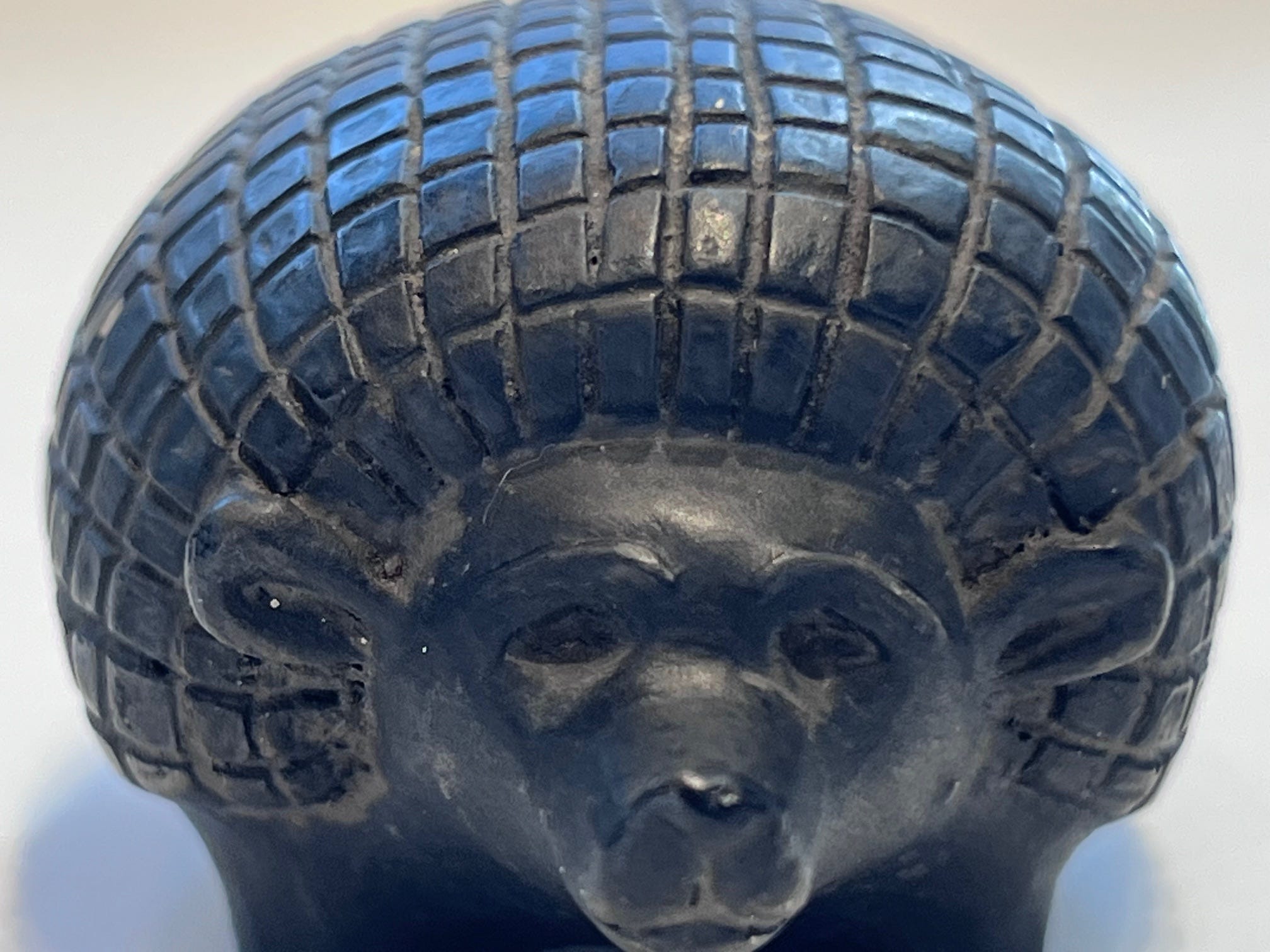
Of course, I never intend to buy anything; having spent hours packing away fragile and personal stuff into the storage cupboards, I don’t want to add anything to the pile of bags and boxes. I just drop in to say goodbye to the owners who know me a little and are familiar with my odd range of interests. But this day, a small figurine in a glass case caught my eye - about the length of my thumb, carved in heavy black stone, it was a hedgehog,. An amulet from Egypt I was told - more accurately a modern copy of an ancient one. I had no idea there were hedgehogs in Egypt or anywhere outside Europe. Or that they featured in any ancient mythologies.
Curious, I bought the amulet for the ridiculous, end of the day price of eight euros. She’s in my luggage now, on her way to Australia. Before I left, I looked her up online and discovered that she is the emblem of the Egyptian hedgehog goddess, Abaset.
So, this is not a story about travel, although on my next foray into Egyptian or other ancient world cultures, the search for hedgehogs could well be on my agenda. This is about the lure of the rabbit hole, chasing something small and insignificant that I could not get out of my head.
*****
Abaset is a mystery. In all of Egypt, her name has only been found inscribed in two tombs unearthed in the oasis of Bahariya in the heart of Egypt’s vast western desert, 400 km west of Cairo and the Nile. She’s a goddess venerated during the 26th Dynasty (664 to 525 BCE) but possibly in just this one place.
Her image appears on the walls of the tomb of Bannentiu, an important local official. Abaset looks much like any other depiction of a goddess or queen in any other ancient Egyptian temple or tomb – her face and legs in side profile, her shoulders and torso face on. But with one delightful difference. On her head, she’s wearing a crown in the shape of a vulture and perched on top, a little hedgehog.
I’d never thought of a hedgehog as a great spirit or guide through the underworld. And when I was in Egypt earlier this year, in so many conversations about ancient beliefs and burials, no-one ever mentioned a hedgehog. It was intriguing, an odd fragment of Egyptian mythology that I couldn’t resist.
*****
When I was a child in England, we always had hedgehogs in the garden. My father was quite fond of them - they ate the slugs and beetles that plagued his vegetable garden. In return, he would feed them in the autumn to help them fatten up before the long winter hibernation. Where they slept away the snowy months I never knew, but they would usually emerge again in spring.
Egypt’s hedgehogs hibernate in the summer to escape the fierce heat and wake up again in the cooler autumn and winter months. And this, to ancient Egyptians, was the hedgehog’s spiritual magic, the power to ‘die’ and to be ‘reborn’.
The cycle of death and rebirth was central to Ancient Egyptian beliefs. Pharaohs were buried with boats so that they could sail across the dark night sky - symbolic of death - and return to earth with the sun, the giver of life. They were also buried with the goods and trappings that they would need in the afterlife, and items that could help them on their journeys.
As far back as 2,600 BC, that included hedgehogs – painted on tomb walls, amulets tucked into mummy wrappings, statues and carvings among the grave goods. But it was not only their perceived power of ‘rebirth’ that was important; hedgehogs were also believed to have the power of protection. A hedgehog under threat can roll into a complete ball, its spines protecting its soft, vulnerable under belly from attack by birds, snakes or scorpions. If you’ve ever read Alice in Wonderland, you’ll probably remember the Red Queen playing croquet, mallet in hand, rolled up hedgehogs the balls.
Hedgehog boats have also been found in tombs, the little creature’s body curled like a canoe, with its head and snout bent inwards to protect those inside. So, the hedgehog’s magic could both keep the dead safe and share with them the power to be born again.
Despite several visits to ancient Egyptian tombs and to the old Egyptian Museum in Cairo, I can’t remember ever seeing a hedgehog amulet or carving or painting. I can’t have been looking closely enough. If the new Grand Egyptian Museum is open by the next time I visit, I’ll have to find a guide who can give me the hedgehog tour. And I’ll make my way to the desert temple to visit the goddess with a hedgehog on her head.
*****
Down in the depths of the internet, my guide through the rabbit hole, I learned that beliefs about the mystical powers of hedgehogs go back much further than Abaset the goddess. They appear in in the Near East, in old Babylonian art and votive offerings from at least 4,000 BCE. Ancient Greeks and Romans saw them as knowledgeable, wise and hard-working creatures, and believed that they could predict the wind and the weather.
In the Middle Ages, in England and Ireland, they were believed to be witches in disguise, or possibly witches’ familiars, that stole cow’s milk straight from the udder and hen’s eggs from the nest. So dire was this perceived problem that in the 16th century, the English Parliament announced a bounty of threepence for every hedgehog killed. Consulting AI, the reward for four dead hedgehogs could buy you a good leather doublet or a couple of weeks’ food and lodging in Elizabethan England.
Both Romans and Romanies believed that ground-up hedgehog spines could cure baldness. I haven’t been able to find anything to tell me how they used the powerful powder - did they eat it or make it into a paste to plaster on a bald head? Either way, it doesn’t seem to be a suitable fate for an animal that they also thought was knowledgeable and could prevent you from being poisoned, targeted by evil spells or going blind.
In Mongolian mythology, a hedgehog is dishonest and will bring bad luck to your house but in Chinese tales, if you feed a hedgehog, it will bring you prosperity. In some parts of Africa, hedgehogs give good advice and grant wishes to those lucky enough to meet one. Presumably, in the winter.
I find it hard to believe that such a cute little creature - one of the oldest mammals on earth - could inspire so many different beliefs and stories and fears among so many different cultures over such a long period of time. The hedgehog is that mysterious, that magical.
*****
Sadly, the common little hedgehog of my childhood garden is in danger of extinction. Numbers are plummeting all over Europe, Ireland and the UK. The hedgehog was not built for the 21st century - pollution, pesticides, cars and loss of habitat are killing them off.
Perhaps there’s hope. In 2013, the hedgehog became the national wildlife emblem of Britain and in 2016 it was voted the UK’s favourite mammal. There’s even a hedgehog preservation society. I have my fingers crossed for its success.
I can still see my father feeding our hedgehogs in the garden, autumn frost turning the grass silver and white. And I can almost hear my mother reading Mrs Tiggy Winkle to me - Beatrix Potter’s tale of the kindly hedgehog who did laundry for the squirrels and rabbits that lived in the woods. Worldwide, it is still one of the most popular children’s books.
Perhaps that’s why the little black stone Egyptian hedgehog is travelling with me to Australia, where there are (unrelated) spiny ant-eaters but no hedgehogs. She can be the first.